An integrated financial system for modern corporate liquidity management

An integrated financial system for modern corporate liquidity management

An integrated financial system for liquidity management, risk analysis and budgeting — all in one intuitive tool.

Business need

Many companies struggle with issues related to cash flow management, budget planning, and monitoring liabilities and receivables. They lack a centralised tool that not only allows them to enter data, but also provides real, cumulative information for further analysis and contextual notifications to support financial decision-making.

Our goal

The aim of the project was to create a modular financial system that enables the management of invoices, budgets, cash flows, and relations with contractors — taking into account real business scenarios, specific legal and tax forms, and the level of cash flow.

System modules
The system was designed as a web application consisting of several integrated modules, which together form a coherent environment for managing the company’s finances.
Ikona
Notifications
  • Sidebar launched from a dedicated bar.
  • Real-time notification list, grouped by day.
  • Ability to navigate to specific resources (e.g., invoice details after clicking on a notification).
  • Notification deletion.
  • Well-designed UX/UI ensuring quick access without disrupting current work.
Ikona
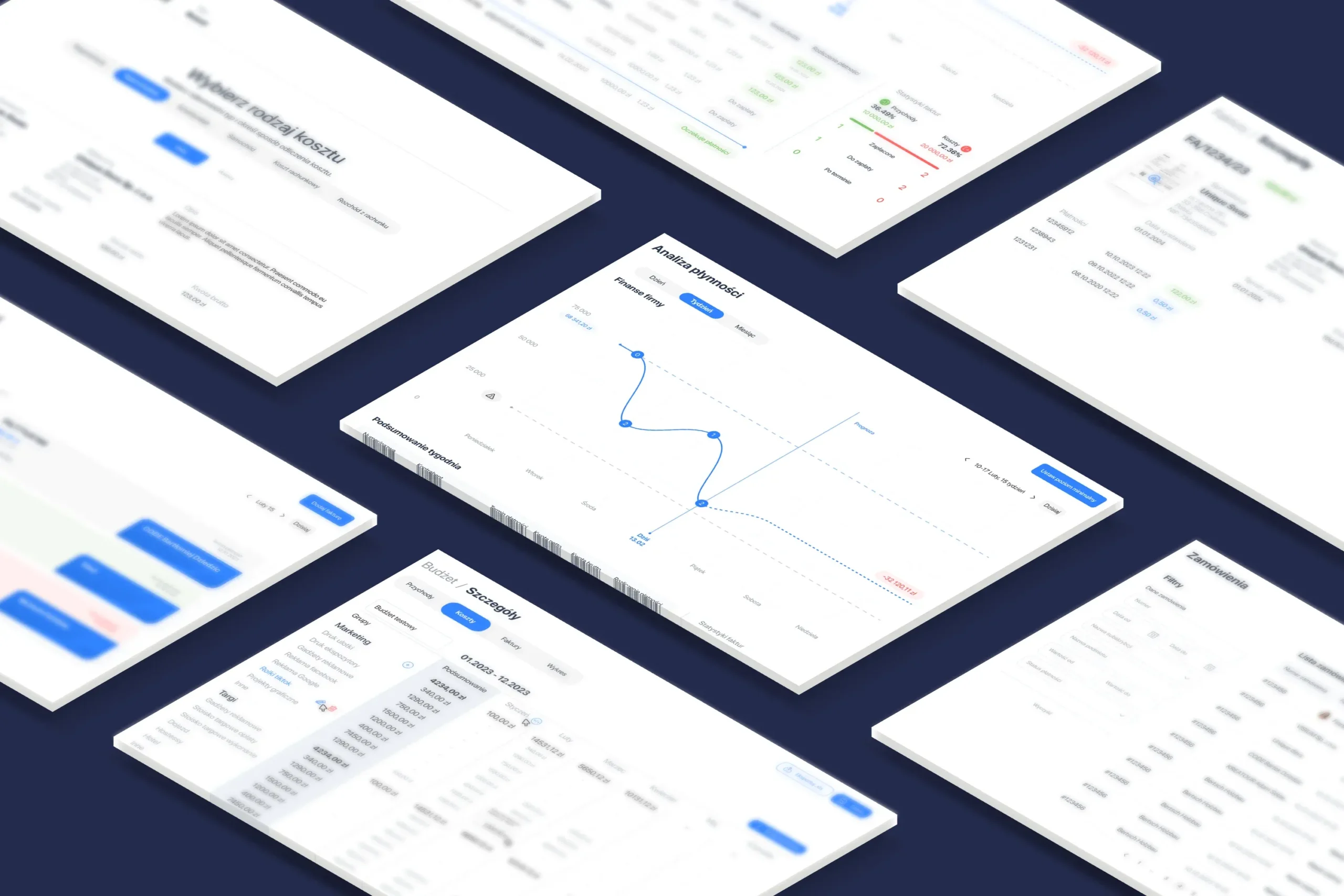
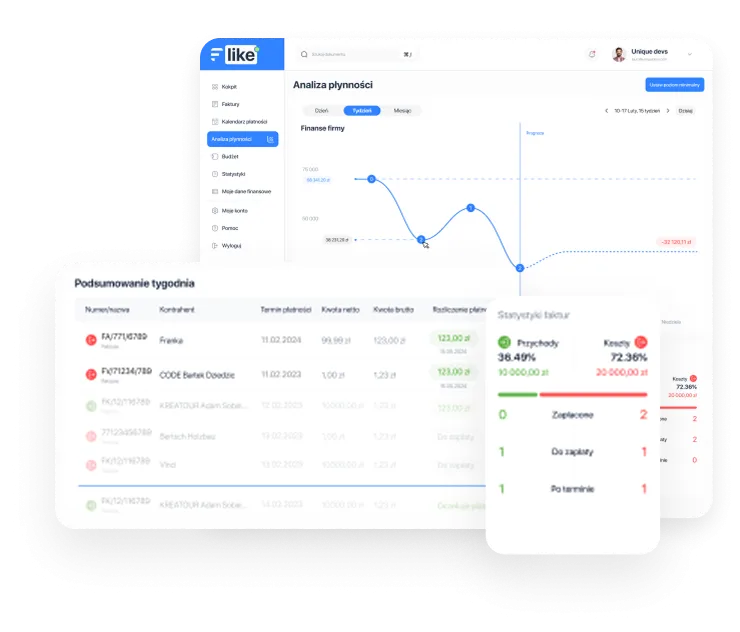
Financial analysis The analytical visualization allows for dynamic assessment of the company’s financial situation. Main functions:
  • Assessment of cash flow:
    • Coverage of fixed costs (e.g., salaries, leases, taxes) in relation to available funds.
    • Coverage of variable costs, taking into account planned revenues.
  • Risk forecasting:
    • The ability to set a “minimum safe amount” in the account and notify of the potential risk of falling below this value.
  • Negotiation suggestions: signals to extend/shorten payment terms based on business data.
  • Cost structure:
    • Share costs in revenues.
    • Costs by place of origin (e.g., marketing, operations).
  • Marketing effectiveness:
    • Ability to record and analyze customer acquisition costs vs. revenue generated within the budget.
  • Project analysis:
    • Profitability of individual projects.
“Financial cushion” simulation: how much money is needed to survive a certain period of time without revenue, based on historical data.
Ikona
My financial data A central place to fill in key company data, divided into submodules:
  • Legal form: selection of one of the types of business activity (sole proprietorship, limited liability company, etc.).
  • Taxes: selection of the form of taxation (CIT/PIT), rates, method of VAT settlement (monthly/quarterly).
  • Car leasing: adding company cars with specification of the method of financing and use.
  • Startup data: filling in the main account and VAT values with the start date (forced logic relative to the first invoice).
Website architecture
The entire service was created based on the popular React and Node.js technologies. The project used solutions such as:
Frontend
React + Apollo GraphQL
modern architecture 
for communication with the backend
Tailwind
flexible approach to styling with full support for themes
i18n
Full support for translations – all texts are subject to localization.
AutoAnimate
animations that improve UX without overloading the interface
React-hot-toast
toast messages for current user information
Recharts
charts and analyses presented in an accessible format

Backend

____/ NestJS + GraphQL (Apollo Server)
modular structure, high security,
easy scalability.
____/ MongoDB
flexible database, works perfectly 
with dynamic data structures.

____/ AWS S3
file storage, e.g., accounting documents.

Tests

____/ Unit tests of domain logic
e.g., cash flow calculation rules.

____/ Integration
e.g., handling notifications or data completion.

____/ E2E
e.g., scenario simulation: lack of funds → notification → transition to invoice → budget planning.

Selected technical solutions of the application
The web application features a number of customised solutions dedicated to its creation:
Ikona
Type synchronization Type interfaces between the frontend and backend have been integrated (e.g., using graphql-codegen), which reduces the risk of errors and improves the developer experience.
Ikona
Color themes The interface color scheme depends on the theme selected by the user (light/dark). Stored as a central configuration object with global access.
Ikona
Validations and domain rules Example: the system does not allow VAT account details to be entered if the user has not indicated that they are a VAT payer. Another rule: start dates must refer to the day preceding the first invoice, which prevents logical errors in analyses.
Ikona
Testing A comprehensive testing strategy has been implemented: E2E (Playwright, ultimately replacing Cypress) 
e.g., accounting documents.

Additional features

NIP verification

cron job that checks the validity of NIP numbers for companies.

KSeF verification

integration with the National e-Invoice System planned.

Administration panel

simplified frontend based on React + GraphQL, designed for user management and system configuration.

Summary

The Flike system is not just another accounting tool—it is simple but an intelligent financial assistant that supports management decisions in micro, small and medium-sized enterprises. 
Its well-thought-out architecture, modular design, and emphasis on usability allow the tool to grow with the company 
and enable more informed, predictive, and effective financial management.

Conclusions and benefits
Thanks to the system we have created, users gain:
  • Full control over company finances
    including analysis of cash flow, cost structure, and risks.
  • Dynamic, contextual notifications
    Instead of searching for information, the system informs the user when a problem arises or action is needed in the future.
  • Personalization
    the ability to adapt the system to the type of business, form of taxation, VAT, and other parameters.
  • A solid foundation for further automation
    e.g., budget planning, predicting future cash flow problems.
  • Increased operational efficiency
    including through centralization of information, better reports, and the ability to respond quickly.
Previous
Next
Connected case studies
See all